The Origin Story on a Package Is Not the Whole Supply Chain
Food origin labels identify different parts of a supply chain. Learn to distinguish ingredient sources, processing locations, and packing claims before you decide what a package tells you.
A jar marked “Product of Italy” may tell you where the finished food is associated with, but it does not necessarily identify where every ingredient was grown or where the packaging was made. Food origin labels are most useful when you connect each phrase to the particular ingredient or production stage it names.
Food origin labels make specific, bounded claims
A place on a package might refer to the finished food, a particular ingredient, or a stage such as processing or packing. The exact meaning can depend on the wording and the labeling rules that apply in the market where the food is sold, so avoid treating a phrase as a complete account of the supply chain.
“California almonds” points to the almonds; “packed in California” points to a packing location. “Made in Canada” describes manufacturing in Canada, but by itself does not establish that all agricultural ingredients were sourced there.
It is not worth trying to reconstruct every supplier from a front label that does not provide that information. Identify what the package actually says, then leave unstated stages open.
Growing, processing, packing, and shipping are different stages
Food may pass through several places before reaching a store. Crops can be grown in one country, milled or preserved in another, and packed elsewhere. For animal products, raising, slaughter, and processing may also happen in different locations.
Pay attention to the action attached to a place. “Grown in” concerns cultivation. “Roasted in” describes processing. “Packed in” identifies a packing location, while “distributed by” generally identifies a business relationship or distribution point, not necessarily a farm or factory.
One stage does not stand in for all the others. A product packed in a place can contain ingredients from elsewhere; a crop grown in a place may be transformed outside it.
The product name can narrow an origin claim
A named variety, regional specialty, or single-origin ingredient may make a more specific claim than a general country label. Read the wording closely: a named source for coffee beans, for instance, does not necessarily identify where they were roasted or where the finished coffee was packaged.
Consider which ingredient or product the place modifies. “Greek olives” points to the olives, subject to the rules that apply where the product is sold. “Greek-style dressing” describes a style and does not, on its own, establish where its ingredients were grown.
Similarly, “made with New Zealand milk” names the stated source of the milk. It does not necessarily tell you where other ingredients came from, where the finished product was made, or where it was packaged. Local labeling rules and the full wording on the package matter.
A company address is not automatically an origin statement
A manufacturer’s or distributor’s address can help you contact the business, but it is not necessarily a sourcing claim. A brand may be based in one country while making or packing food elsewhere, and it may source ingredients from multiple locations.
“Manufactured for” and “distributed by” describe business relationships; a customer-service address provides a contact point. None of those details alone identifies the farm, mill, or factory. Treat the address as company information unless the package separately connects it to a production stage.
Flags, maps, and regional landscapes can suggest a place without stating which stage happened there. Give explicit wording more weight than decorative imagery.
Compare origin claims by the question they answer
One package may name a country for a main ingredient, while another states where the finished product was made. Neither is more informative for every purpose. Choose the wording that addresses the stage you care about, and use the result to decide what to ask or compare next.
- If the label says “grown in” and the named place is the growing location you want, treat it as information about cultivation; if it names a different place or leaves the crop’s source unstated, look for a direct ingredient-origin claim.
- If the label says “roasted in” and you want to know where processing happened, treat it as a roasting claim; if you want the growing location too, seek separate wording about where the crop was grown.
- If the label says “packed in” and packing location matters to you, treat it as information about packing; if you want to know where ingredients came from, seek their origins separately.
- If the package gives a company address but no production-stage wording, treat the address as contact or business information; if origin matters, ask the company which stage, if any, that location refers to.
- If a phrase names one ingredient, treat it as a claim about that ingredient rather than the whole product; if you need information about the rest, check for separate claims or ask about those ingredients.
- If the wording is unclear or could be read in more than one way, compare the full package text with the rules for the market where it is sold; if that still does not answer your question, contact the company with a specific question about growing, processing, or packing.
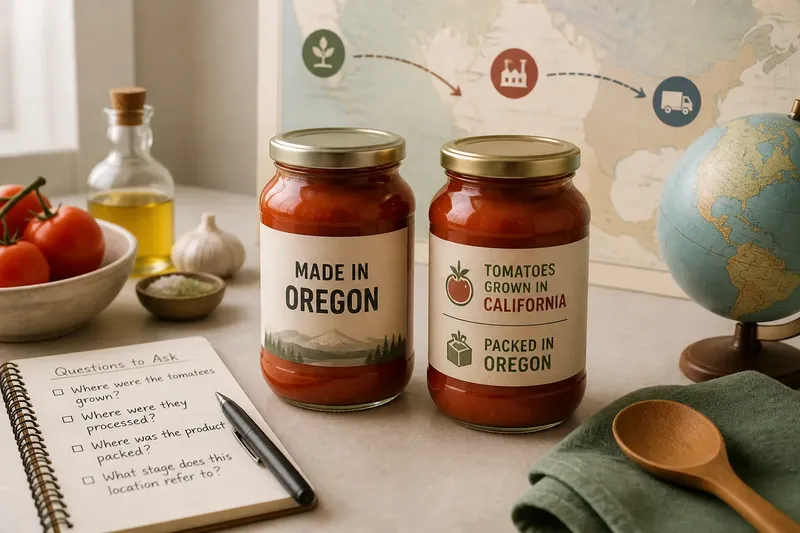
Say you are choosing between two jars of tomato sauce and, for this invented situation, the labels read “Made in Oregon” and “Tomatoes grown in California, packed in Oregon.” First, you identify the question: where the tomatoes were grown. Next, you match each phrase to its stage: the first names a manufacturing location but does not state the tomatoes’ growing location; the second expressly names a growing location and a packing location. The second jar therefore gives a direct answer to that particular question, while neither label necessarily describes every supplier or ingredient.
What should you ask when a label leaves details open?
Does “made in” tell me where the ingredients were grown?
Not by itself. It identifies a manufacturing location, while ingredient origins may be different or unspecified.
Does “packed in” identify the food’s source?
It identifies where packing took place, not necessarily where the food or its ingredients were grown. Look for separate origin wording if growing location is what you need to know.
Does a company address show where a product was made?
Not necessarily. An address may be for a manufacturer, distributor, or customer service; check for wording that explicitly connects a location to production.
What should I ask a company about an unclear claim?
Ask which stage the place refers to, such as growing, processing, or packing. A focused question is easier to answer than a broad request for where the product is “from.”
Match the claim to the decision you need to make
Every origin statement has a boundary. It may name one ingredient but not the rest, one production stage but not the others, or a region without naming a farm. An accurate claim can still leave parts of the supply chain unspecified.
When a detail matters, ask narrowly: “Where were the beans grown?” is more precise than “Where is this from?” You can also ask whether a stated place refers to cultivation, processing, or packing. The company may clarify the claim, or the available information may remain limited.
Reading food origin labels carefully means matching the claim to the stage it names. That distinction is useful even when the package cannot answer every question: it keeps an ingredient source, a factory location, and a company address from becoming the same story in your mind.