The ingredient list has an order. Here is how to read it.
Ingredient list order helps you compare similar foods and spot relative ingredient differences, while showing why position alone cannot reveal exact amounts.
Ingredient list order can help you compare similar foods, but its meaning depends on the labeling rules that apply to the product. In the United States, ingredients generally appear in descending order by weight, subject to exceptions in labeling regulations; other jurisdictions may use different rules.
That makes the sequence a useful clue, not a recipe or scorecard. A familiar ingredient appearing higher in one comparable product than another may signal a difference in relative weight, but the list does not give exact quantities or settle which product better suits your needs.
Ingredient list order offers a relative clue
For many packaged foods sold in the United States, ingredients are listed in descending order by weight, with specific regulatory exceptions. The first ingredient is generally the heaviest individual listed ingredient under the applicable rule; it is not necessarily more than half of the food. Because rules vary by jurisdiction and product, check the local labeling guidance when a precise interpretation matters.
The sequence does not tell you how many grams of an ingredient are present, how much remains in a serving, or how the finished food’s proportions compare after processing. Water loss or gain during preparation can change the finished product without making the list a direct description of what is in each bite.
For instance, a soup listing water before lentils does not reveal the exact lentil content in a bowl. Use the nutrition facts panel and serving information for nutrient amounts, and look for a stated ingredient quantity when the package provides one.
Similar products make the clearest comparison
Ingredient order is easiest to interpret when products serve the same purpose and have broadly similar recipes. Comparing two plain yogurts, for example, may show whether a sweetener appears higher in one list. That is a clue about its relative weight in each product, not a direct measure of sweetness.
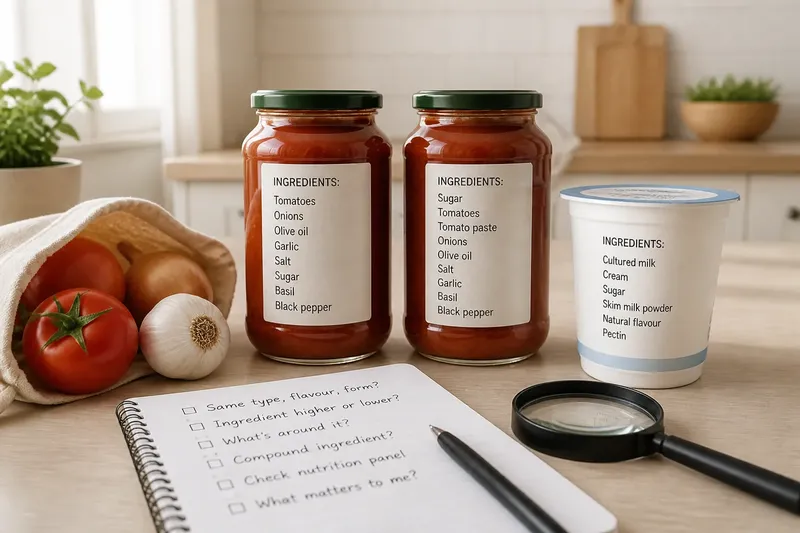
Match product type, flavor, and form before drawing a conclusion. A strawberry yogurt and a plain yogurt may differ because one contains a fruit preparation; concentrated soup and ready-to-eat soup may use water differently. Those differences make position harder to compare directly.
Say you are choosing between two tomato sauces for the same meal. In one, tomatoes appear before added sugar; in the other, sugar appears before tomatoes. Under the applicable descending-weight rule, that ordering suggests sugar has a greater relative weight than tomatoes in the second sauce, while the reverse is true in the first. The nutrition panel, serving size, and your own taste preference still matter to the decision.
The first ingredient does not describe the whole food
The first entry is generally the largest ingredient by weight under the relevant labeling rule, but the ingredients after it can outweigh it together. A first-place ingredient therefore does not mean the product is mostly that ingredient.
A food’s name or front-of-package description may emphasize an ingredient that appears farther down the list. Position can prompt a closer look, but it cannot by itself establish whether a product name or claim complies with local labeling rules.
If the amount of a particular ingredient matters to your choice, look for a declared quantity where one is provided. Without one, the sequence remains a relative clue rather than a precise answer.
Low position does not mean no effect
An ingredient near the end of a list is generally present at a lower weight than ingredients above it, but small amounts can still affect flavor, texture, or how a food is made. Spices, acids, flavorings, and leavening ingredients may matter even when their mass is modest.
Position also cannot tell you whether an ingredient is suitable for a particular person. If you need to avoid an allergen or follow medical dietary advice, read the full ingredient list and any separate allergen statement. Ask a qualified health professional about individual medical concerns.
Some products contain compound ingredients, such as a sauce or seasoning blend. The package may list components within that mixture, but their appearance does not provide a precise breakdown of their quantities in the finished food. A long sub-list can look prominent without making that mixture the largest part of the product.
How should you compare ingredient list order?
Start with one specific question, such as which of two similar products lists a particular ingredient higher. Then use the surrounding package information to decide whether that clue matters to your choice.
- Check whether the products match. If they have the same type, flavor, and form, compare their lists directly; if not, treat differences as clues rather than a like-for-like comparison.
- Check the ingredient you care about. If it appears higher in one comparable product, note that it generally has greater relative weight there; if it appears lower or is absent, consider whether that changes your choice.
- Check the entries around it. If the neighboring ingredients differ, factor those recipe differences into your judgment; if the lists are otherwise similar, the change in position is easier to interpret.
- Check for a compound ingredient. If a sauce, blend, or preparation has its own components, do not treat their order as a precise breakdown of the whole food; if the component matters, look for a separate quantity declaration.
- Check the nutrition panel for nutrient amounts. If sugar, sodium, fiber, or another nutrient is your concern, compare the relevant panel information; if it does not answer your question, ingredient rank alone cannot fill the gap.
- Check your actual priority. If taste, an allergy, dietary advice, or cooking use is decisive, let that guide the choice; if none is decisive, use ingredient order as one modest comparison clue.
It is not worth counting every ingredient or assuming the shortest list is automatically preferable. A longer list can reflect a more complex food, while a short list can still include something that does not suit your needs.
What can ingredient list order not tell you?
The sequence cannot give exact quantities, show how much of each ingredient remains in a serving, or describe a food’s full nutritional value. It also cannot establish how an ingredient was sourced, how extensively a food was processed, or whether a marketing description is meaningful for your needs. Those questions call for different package details or other relevant information.
Lists can also be difficult to compare when products use different forms of an ingredient. Whole fruit, fruit concentrate, and fruit preparation are not interchangeable entries, and their positions alone do not explain how their contributions compare for taste or dietary purposes.
For a specific term or disclosure, read the full package wording and consult applicable local labeling guidance or manufacturer information. If the answer affects a medical need, ask a qualified professional.
Does ingredient list order answer every comparison question?
Is the first ingredient the heaviest?
Generally, yes, under the applicable rules for products such as many packaged foods in the United States. Exceptions and rules in other jurisdictions mean the label’s exact interpretation can depend on where and how the food is sold.
Can I tell the exact amount from the list?
No. Position gives a relative clue, not a quantity. Look for a declared amount if the package provides one, and use the nutrition facts panel for nutrient information.
Should I choose the product with the shorter list?
Not on that basis alone. List length does not show whether a food suits your preferences, dietary needs, or intended use.
What if an ingredient appears near the end?
It is generally present at a lower weight than ingredients above it, but it can still affect flavor, texture, or suitability. Read the full list if that ingredient matters to you.
Ingredient list order is most useful as a modest, concrete clue when comparing similar foods. Use the phrase “ingredient list order” as a prompt to ask what the sequence can actually tell you, then check the nutrition panel, product type, and your reason for choosing the food. The label informs the decision; it does not make it for you.